
Preserving Doctor Who Episodes
Video by Christopher John Ball.
Film is Fabulous! endeavour to provide insight into the restoration of the two recovered episodes of ‘The Daleks’ Master Plan’, prior to these being released on BBC iPlayer this Easter.
Having recovered two missing episodes of Doctor Who from a private collection, key members of the Film is Fabulous! team took the original 16mm prints to R3Store Studios in London. The experts at R3Store were commissioned by BBC Archives to prepare, clean, and digitally scan the film prints, and to complete the restoration work on the visuals and soundtrack.
The first task was to examine the prints, to check the cement joins, and to identify and repair any damage present. There was minor perforation damage (around the sprockets and one frame) on a short section of the first print: ‘The Nightmare Begins’. This required attention. Fortunately, both 16mm prints were in generally good condition with only light to medium wear.
New, longer, leaders and tails were added, to both prints, and the prepped films laced through the mechanical cleaner. A combination of chemical application, buffing and drying over the various rollers, followed. The 16mm prints were subsequently ready for scanning.
R3Store Studios offer state-of-the-art digital scanning of film. Tests were run on two different scanners, and it was determined that the best results would be obtained from the LaserGraphic ScanStation 6.5K. Accordingly, the 16mm print of ‘The Nightmare Begins’ was laced-up, and the scanning commenced.
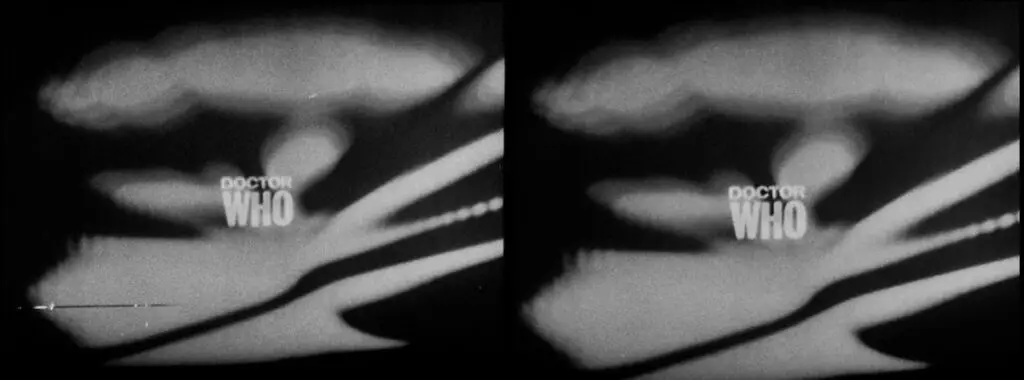
Within seconds, the famous Doctor Who opening titles appeared on the monitor and the theme music began. These were swiftly followed by the titles of the recovered episode.
Jo Griffin, Digital & Restoration Director at R3Store Studios, confirmed the following stages of the restoration process were undertaken by the team:
‘We used a range of restoration tools on Phoenix to return these two episodes as closely as possible to their original broadcast appearance.
Over time, film naturally degrades it can shrink, warp, and lose stability so our first step is to stabilise the image by effectively “pinning” the four corners of each frame.
From there, we apply a de-flicker process to correct fluctuations in brightness, followed by an automated dirt pass that identifies and removes black and white specks. This is supplemented by a meticulous manual clean-up to address any imperfections the automated process may have missed.

Because automated tools can sometimes introduce artifacts, every pass is carefully reviewed on a shot-by-shot or scene-by-scene basis to ensure any unintended issues are corrected.
The final stage involves subtle sharpening and targeted noise reduction to enhance clarity while preserving the integrity of the original image.
To restore the audio, we used newly developed source separation techniques and processes which allowed the different elements of the soundtrack to be isolated before any restoration work began. By separating out the dialogue first, noise reduction was applied only to the remaining elements, completely avoiding the risk of artefacts affecting the speech.
The result is cleaner dialogue that retains its original character. Given the soundtrack had accumulated noise at every stage, getting as close to the source as possible was the ultimate goal.’
Film is Fabulous! is immensely grateful to the team at R3Store Studios for allowing filming to take place. For more information on the restoration of film, please visit: r3storestudios.com
MAKE A DONATION
Film is Fabulous! urgently need your support, in order to preserve vulnerable film treasures. Please select an amount from the drop-down box adjacent, and make a one-off payment via PayPal. Options available:
- £5
- £10
- £25
- £50
- £100
If you’d like to donate a larger amount, as a one-off payment, or make a regular donation each month, please email: donate@filmisfabulous.org.uk
Film is Fabulous! Preserving film treasures for future generations.
24th March 2026
Share this post