
Exclusive Annette Andre Interview
Oliver Crocker examines the genesis of Emergency Ward 10, Britain’s first twice-weekly serial drama, with memories from special guest star Annette Andre.
Nearly 70 years ago, one of television’s greatest fairytales took place behind the scenes – an extraordinary and wholly unlikely success story, almost impossible to imagine happening today. Associated TeleVision (ATV), one of ITV’s original ‘Big Four’ companies, discovered the jewel in their crown: Tessa Diamond, a complete newcomer to television who was about to create television history.
Having worked as a radio announcer in South Africa, the 25-year-old moved from her native Johannesburg to Britain in 1956 and called in, uninvited, at ATV’s London office to enquire if they had any scriptwriting vacancies. Remarkably, Diamond was told to grab some lunch and, on her return, started working as a continuity writer in the promotions department that very afternoon.
As Tessa explained to Patricia Lewis in an interview for London’s Daily News in January 1957, after a few “tedious” months writing the announcements encouraging viewers to stay tuned and not reach for the remote, the ambitious Diamond expressed her desire to write for the programmes themselves. Having initially asked ATV’s programme controller Bill Ward if there was anything “more in the documentary line” she could develop, script editor Harold Jamieson advised her that “the market is wide open for serials, but don’t get too ambitious, often really experienced people are the only ones who can do it properly….”
Having developed a batch of treatments for potential series, it was Diamond’s idea for a series following a probationer nurse that producer Antony Kearey felt “would be a winner…” and Tessa was given three weeks’ leave to knock her first script into shape. In an interview for the TV Times in February 1957, Diamond described her heroine, Pat Roberts, as a 19-year-old farm hand who had spent half her life “looking forward to the day she could put on the cap, cuffs and apron of a probationer nurse… But she has not even guessed at the daily drama, the essential discipline, the humour, the heartbreak, and the sheer wear and tear on the feet that go to make up every 24 hours of hospital life.” Laying the foundations for thousands of characters that have since followed on UK television, Pat Roberts was billed in the press and being ‘new to the world of TV fiction.’
Cast in the groundbreaking central role was New Zealand-born Rosemary Miller, who had just starred as Ann Pilgrim in ITV’s Saturday night thriller The Trollenberg Terror. Interviewed for the Liverpool Echo in August 1957, Miller stated that Emergency Ward 10 was “the biggest thing I have ever done and the most satisfying too…” The star revealed she received 70 “serious letters” a week from would-be nurses, hospital patients and members of the public awaiting operations: “They find the series wonderfully interesting – and immensely consoling. The facts, for one thing, are always right, for a nursing sister and a doctor are always on call when advice is needed.”

Realism was key for Tessa Diamond, who told the News Chronicle’s James Thomas in April 1957 that: “My father was a doctor and that helped me a bit with atmosphere… Now I’m going to tour the London wards again. It’s important to keep the authentic atmosphere – but it’s also important to know what hospital staffs are saying about the serial.” Tessa’s scripts stood up to medical scrutiny, as the Birmingham Mail confirmed in May 1957: ‘medical and nursing staffs agree that authenticity has been translated to the screen.’
Viewers had been admitted to Ward 10 for the first time on Tuesday 19th February 1957, when The Daily Herald announced that ‘Tessa makes TV history! For the first time since TV started in Britain, viewers are to get a twice-weekly serial…’ Initially envisaged as a six-week ‘fill-in’ on Tuesdays and Fridays at 7pm, the first 12 episodes were all written by Diamond. Cunningly scheduled immediately after The Archers had finished its daily radio broadcast, Emergency Ward 10 exceeded all expectations when its audience increased by 50% during the first batch of stories, attracting 2.25 million households (approximately 6 million viewers) – over a third of the UK population who owned a television set in 1957.
Voted ‘best regular programme on television’ in a News Chronicle Top Ten poll, Emergency-Ward 10 was quickly extended for a further six-month run. Hazel Adair and Rachel Grieve joined the scriptwriting team to ease the tremendous workload on Diamond, whose salary had now trebled from her continuity days – although as an ATV staff member, she would controversially not receive any royalties as the creator of Emergency Ward 10. Each scriptwriter was allocated their own doctor and a nurse adviser, who were on call to offer guidance to ensure consistent procedural accuracy.
Interviewed for the Evening News by Kendall McDonald – who felt Emergency Ward 10 was ‘doing a deal of good, as well as providing entertainment’ – producer Antony Kearey explained that the juggernaut production had also taken steps to lighten the load for its hardworking regulars: “The cast have been rehearsing and appearing for seven days a week, but now we have it worked out so that they will get time off and certain characters will be written out now and again so that they can take summer holidays.”
The cast and crew were allowed only three days to rehearse each 25-minute episode to keep up with the demands of the gruelling schedule. In August 1957, the Daily Mirror’s Raymond Bowers visited the rehearsal set to discover Tessa Diamond scouring through all the day’s newspapers, checking for any medicals news that she could inject into that episode’s script. Diamond explained to Bowers: “Last week, nurses got a 5% increase in salary and new lines about it were fed to the nurses in the serial.”
In August 1957, the results were in from The Daily Herald, who commented how Emergency Ward 10 had ‘doled out 1,300 minutes of medicated pleasure. Yet viewers are still lapping it up. Other shows would have reached the boredom stage long ago, but this one is jumping the other way.’ Producer Antony Kearney told reporter Philip Phillips that he believed the show’s success was thanks to “…a change of faces. Only five of the characters in Ward Ten are seen regularly. Week after week, fresh supporting actors pass across the screens, playing their part in the drama and fading out again. This adds interest.”

Many famous faces and future stars passed through the doors of Oxbridge General during the drama’s impressive decade-long run. When theatre actress Sally Graham was admitted with a severe case of sunburn, the producers of the popular soap wanted a star name to play Ward Ten’s new celebrity patient. Cast for this special six-episode storyline was screen legend Annette Andre, who had already played dozens of roles on stage, television, radio and film, both in the UK and her native Australia. Having graced countless Q&A sessions with her memories of working on a host of iconic television dramas, the invitation to attend a Film is Fabulous! event as a special guest to talk about her long-lost appearances in Britain’s first twice-weekly serial was a very pleasant surprise for the star.
“When Rick Davey, the publisher of my memoir Where Have I Been All My Life?, told me that Film is Fabulous! wanted to talk to me about Emergency Ward 10, I thought, ‘Emergency Ward 10? But that was decades ago…’” Annette explains. “Because I was doing so much work through the Sixties and Seventies, flitting around from job to job, sometimes I’ve looked down my list of credits on IMDb and got to some and thought ‘What was that? I don’t remember that…’ But I remembered doing Emergency Ward 10 because there were a couple of funny incidents making it”
“I never saw any of my six episodes go out, because I was working a lot back then. Usually when I got home, I would be getting stuck into my lines and trying to get some sleep before I was off to the studio again. There were no recorders back then, so if you wanted to watch something on television, you had to stay in especially, which in my case would only be for something I really wanted to see. Otherwise, I would be out for dinner or going to a party.”
When Annette joined Emergency Ward 10, only Jill Browne, playing Nurse Carole Young, and Iris Russell, playing Matron Mary Stevenson, remained from the original regular cast, which had now sensibly expanded to meet the demands of the twice-weekly serial. “Regulars in a soap can be a little tricky to guest actors…” Annette explains, “especially if they’ve got used to working with people and then someone new comes in. But the cast on Emergency-Ward 10 were lovely. it was a nice team of people.”
“I was friends with Anne Lloyd [Nurse Jane Beattie] and one night we played poker with John Carlisle [Lester Large] and I won £20, a lot of money in those days, and John couldn’t believe it. He was a nice man. I also knew Tom Adams, because we had worked together on the film This is My Street with Ian Hendry. Tom was playing his ‘mister’ surgeon very stately, but I thought he seemed a bit grim just before one of the recordings. I remember saying to him, ‘Relax, Tom. Just relax.’ Waiting to go on is terrible. What I learned, and I think most of us did, was that the minute you stepped onto the stage, or the minute the camera was on you, it was deep breath time and you just had to do it, no matter what happened. If the door handle came off in someone’s hand, you had to go out the window, darling.”
Though as Annette recalls, the pre-performance butterflies were intensified during one of her Emergency Ward 10 appearances: “I don’t know whether it was the first episode or the second, but something had happened in the studio and they couldn’t pre-record it. Without about 30 minutes to go, we were told ‘The only way we can do this is to do it live, or we’ll have to cancel the episode…’ I’d done a lot of live television in Australia, but since I’d been working in England it had been ‘as live’ recordings, maybe with a bit of filming, so it was a long time since I’d done live. I said, ‘It’s all right. We’ll be fine…’”
“All us actors playing patients were lying on our hospital beds or, in my case, on a trolley. One of the actors said to me ‘God, I’m so nervous. I don’t know what to do.’ He looked at me and said, ‘Aren’t you nervous?’ I said, ‘No, not at all.’ But just minutes before we were due to go live, someone in the crew said, ‘What’s that noise?’ ‘What noise?’ I asked. ‘My God, it’s your trolley!’ It had hit me that we were about to go out live, and I’d suddenly realised ‘Oh no, I haven’t done this for a long time. One little mistake and whoops…’ I was lying on my front and because my heart was beating so fast, my trolley was making this shuddering noise! I said, ‘I don’t know if I can stop this…’ and of course, we all got the giggles! Some of the regulars weren’t too thrilled about doing it live either, but at least they didn’t have a noisy trolley to contend with.”
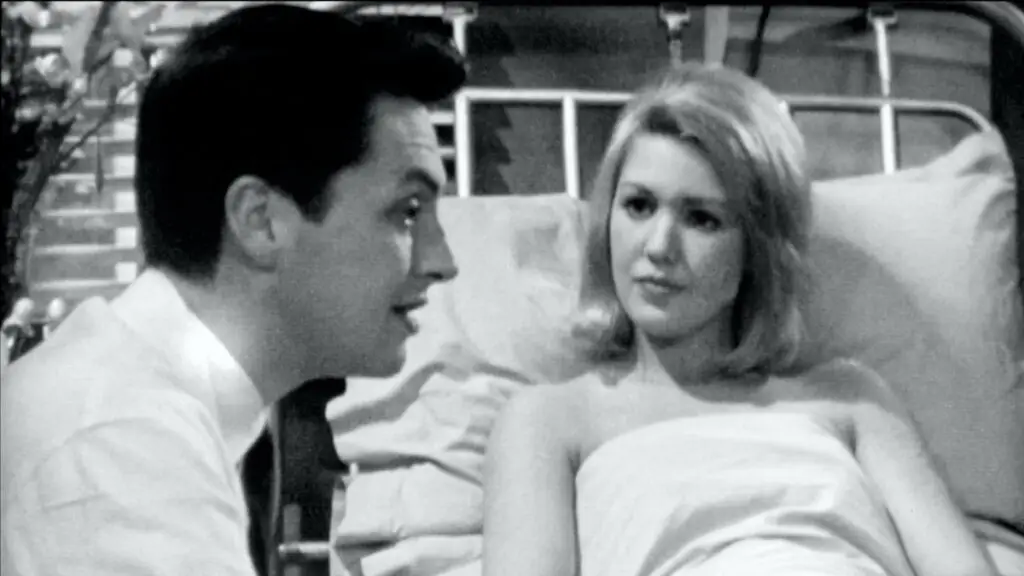
Annette was fascinated to see the opening instalment of her three-week stay on Ward 10 last year, when Film is Fabulous! screened the first of her now fully-recovered six-episode storyline to an appreciative audience for the first time in over 60 years. “I did all my acting lying down on my stomach in the first episode, which was a bit inhibiting, but they wanted to show off my burnt back, which took a long time to do in make-up. I remember thinking to myself that if I moved, it was going to hurt, so I had to imagine that I would feel a lot of pain. Also, there was a little vanity and ego in the character, lying there with all this stuff on her back, so as well as thinking ‘ouch’, I was thinking, ‘how do I look glamorous?’”
Annette also recalls her state of undress causing a good-natured stir amongst the Elstree technicians. “It was very funny because I’d just done an episode of Sergeant Cork where I’d worn a low-cut gown, to which the censors had complained that I’d shown ‘excessively exposed cleavage’. I’d found a shop in Knightsbridge that made pretty French bras and, as my ‘incidentals are no bigger than two lentils’, they were able to build and push me up inside. I’ve never seen Sergeant Cork, so I don’t know how it all worked out, but when I was lying on that trolley on my front, I had a laugh with some of the boys on the crew, who joked ‘Oh come on, show us…’ and I said, ‘You don’t want to see my two lentils.’ That was very funny.”
Whilst Sally Graham modestly claims that she is ‘not a well-known actress’, the same cannot be said of the talented Ms. Andre, one of the most in-demand stars of her generation. In fact, whilst her fourth episode of Emergency Ward 10 was airing on ITV, Annette could also be seen guest-starring in the BBC’s anthology series Story Parade, opposite future Ward 10 heartthrob Ian Cullen and fellow Randall and Hopkirk (Deceased) legend Mike Pratt, that same evening. “During that particular era, I almost worked all the time, to the extent that if you had two weeks off, you’d be going, ‘God, I’m never going to work again!’ Back then, we were able to pop in to say hello to directors and casting directors, have a cup of tea with them and say, ‘Any work coming up?’ But my experiences have no bearing on showbusiness today, which doesn’t even bear thinking about in the same breath as the days of Emergency Ward 10 or all those other wonderful shows we made at Elstree.”
Since Annette’s six episodes of Emergency Ward 10 were watched by over 10 million people (an average of 5.2 million households during the summer months) they were never seen again… until now! Modern audiences will have a chance to examine Sally Graham’s recovery at a special screening at Riverside Studios, when Film is Fabulous! will screen one of the recovered episodes in its entirety, along with a compilation of clips capturing Sally’s complete story arc.
Annette will be in the audience, watching these rarities for the first time: “The work that Film is Fabulous! are doing is absolutely terrific and I’m delighted these episodes have been found. I had no idea at the time that so much of my work would disintegrate and not be preserved. So much has been lost, despite so much going into them. These programmes from the golden age of British television are still so viable as entertainment, they are a form of escapism and imagination that we don’t have anymore.”
“I liked working on Emergency Ward 10; some people in the profession saw the soaps as the bottom of the pack, but they were showing the audience what it was like for people working in a hospital or, as I later found out in Crossroads, running a motel. They weren’t all good, but some of them like Coronation Street had their charm and there was a lot of truth in them. I’m looking forward to seeing some more of my work from Emergency Ward 10 and finding out if Sally Graham ever stood up!”
Thanks to the miraculous recovery of dozens of long-lost Emergency Ward 10 episodes by Film is Fabulous!, Annette Andre is about to be reunited with her entire six-part run in the series.
MAKE A DONATION
Film is Fabulous! urgently need your support, in order to preserve vulnerable film treasures. Please select an amount from the drop-down box adjacent, and make a one-off payment via PayPal. Options available:
- £5
- £10
- £25
- £50
- £100
If you’d like to donate a larger amount, as a one-off payment, or make a regular donation each month, please email: donate@filmisfabulous.org.uk
Film is Fabulous! Preserving film treasures for future generations.
9th October 2026
Share this post